Research

My group combines global simulations, theory, and spacecraft observations to understand how plasma, magnetic fields, planetary rotation, atmospheres, and ionospheres interact across the Solar System. Our publications fall into five connected research themes.

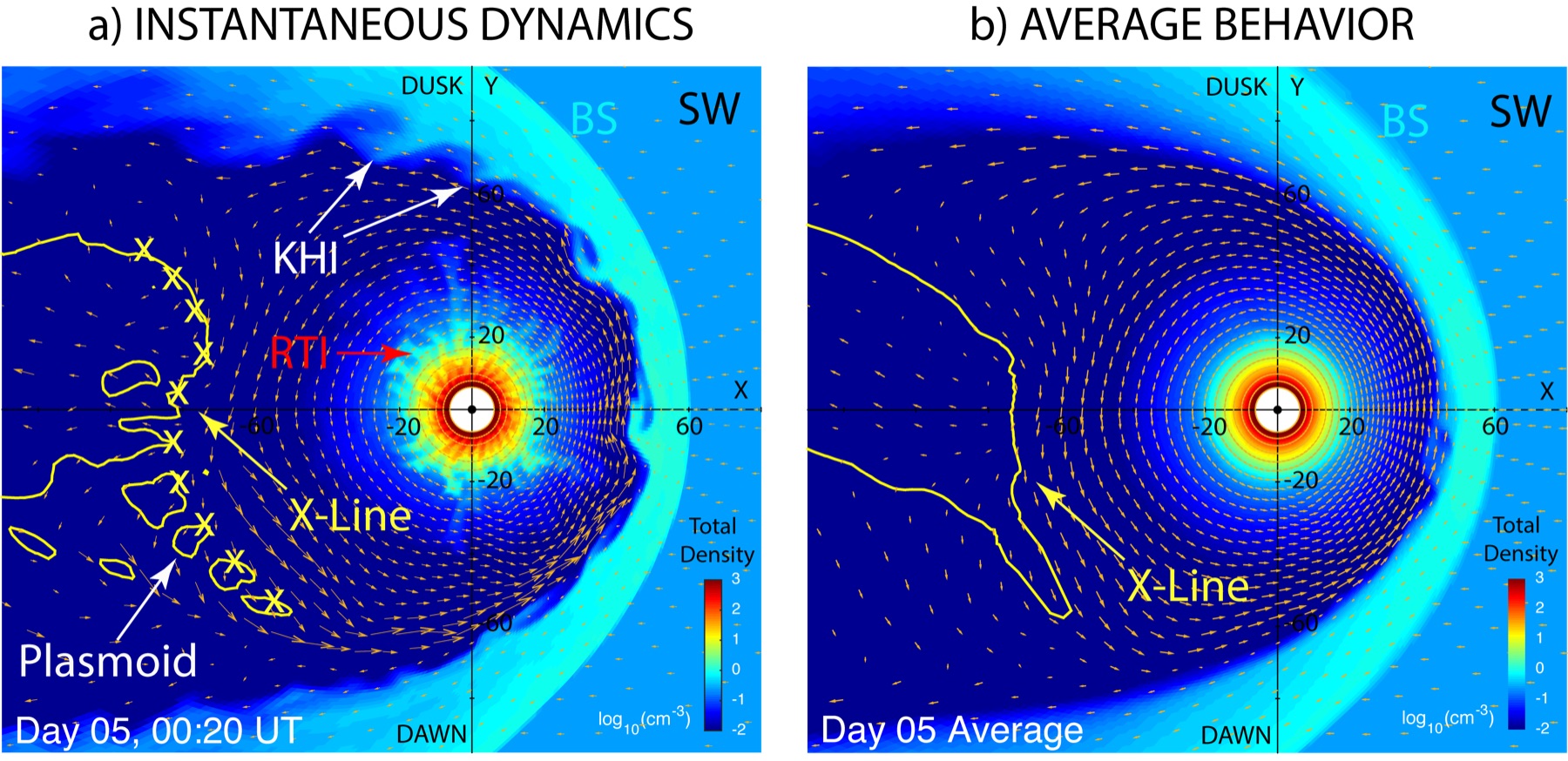
Global Jovian magnetosphere simulation comparing instantaneous dynamics with average behavior

Giant planets and moons

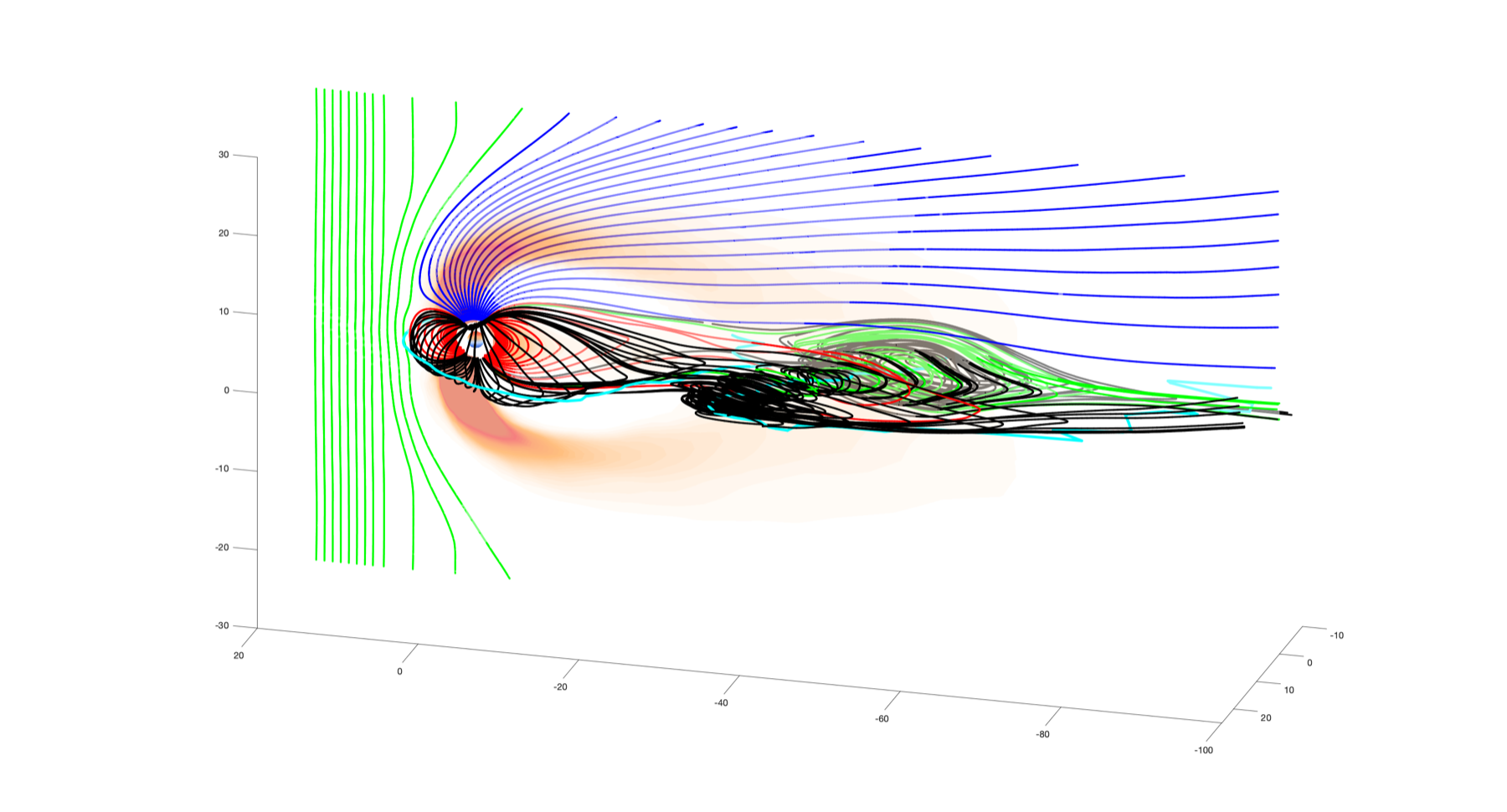
Magnetospheres and aurorae

We combine global simulations and spacecraft observations to study how rotation, internal plasma sources, and the solar wind shape Jupiter, Saturn, Ganymede, and their aurorae.

Key question: How do global magnetic topology and plasma transport connect magnetospheric dynamics to observable aurorae?

Featured paper research

Comparative planetary plasma

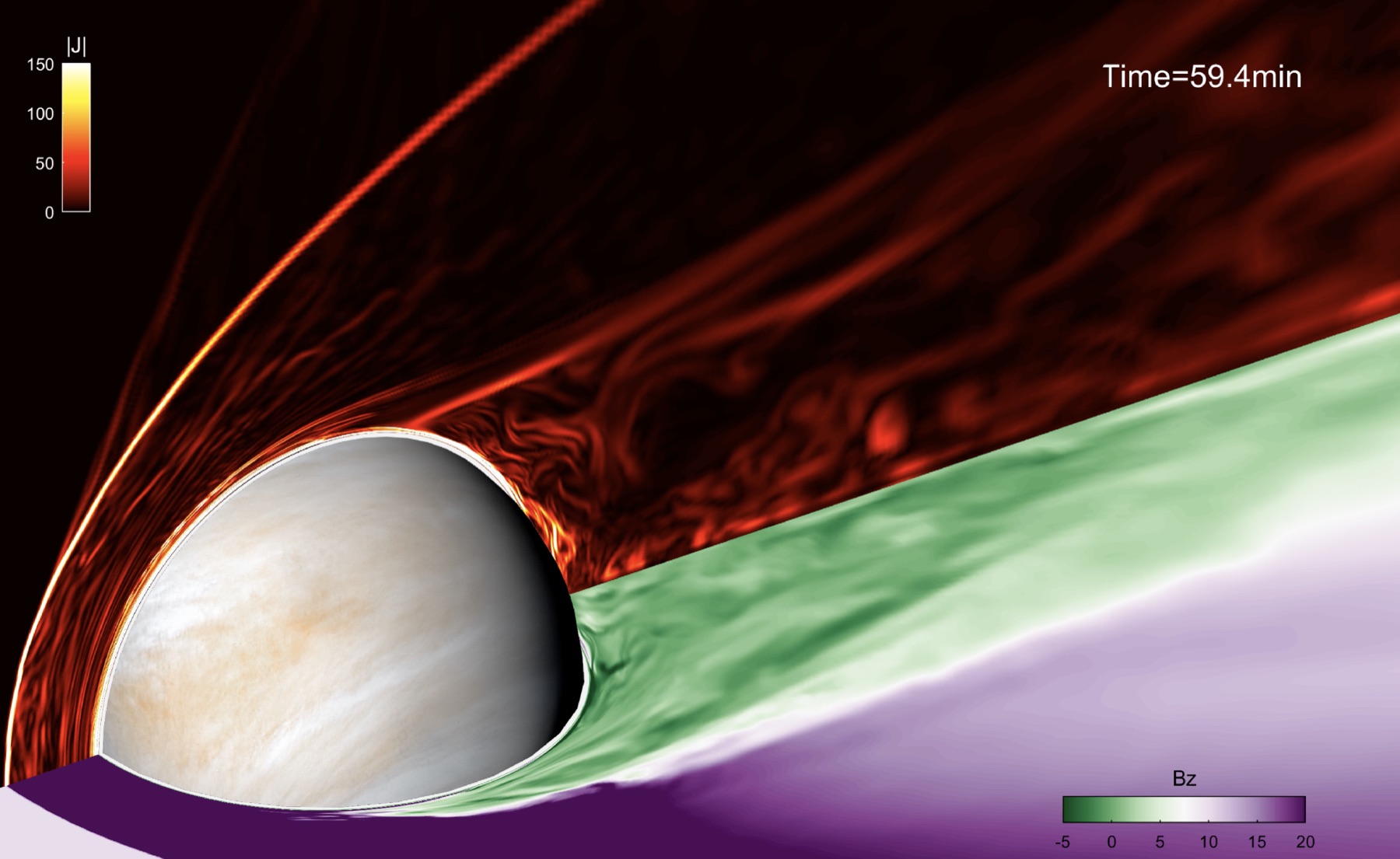
Unmagnetized Planets

We model how the solar wind interacts directly with the ionospheres and induced magnetospheres of Venus and Mars, including extreme space-weather forcing and atmospheric escape.

Key question: How do shocks, reconnection, and boundary instabilities reorganize plasma transport around unmagnetized planets?

Featured paper research

Coupled geospace

Magnetosphere–ionosphere coupling

We study the two-way exchange of mass, momentum, and electromagnetic energy between magnetospheres and ionospheres, from global convection to auroral energy deposition.

Key question: How do conductance, outflow, and Alfvénic energy transport regulate reconnection, substorms, and aurorae?

Featured paper research

Upper-atmosphere dynamics

Ionosphere–thermosphere coupling and space weather

Our coupled simulations trace how geomagnetic storms, atmospheric waves, solar eclipses, and magnetospheric energy input perturb the ionosphere and thermosphere.

Key question: How do these disturbances change density, winds, ion–neutral coupling, and satellite drag?

Featured paper research

Computational plasma physics

High-order numerical methods and global MHD

We develop conservative, geometry-aware numerical algorithms and scalable global models for plasma dynamics on orthogonal and non-orthogonal curvilinear grids.

Key question: How can high-order finite-volume schemes remain accurate, stable, and conservative on complex global grids?

Featured paper research