
Binzheng Zhang Research Group · The University of Hong Kong
Planetary Space Environment Modeling Group
We build virtual planets—and let the solar wind break them.
We use high-performance simulations to study planetary magnetospheres, aurorae, space weather, and the plasma dynamics that connect planets to their space environments.
Simulation showcase
Jupiter’s magnetosphere in motion
Follow the evolving magnetic field as a rapidly rotating Jovian magnetodisc stretches into a vast, dynamic magnetotail.
Right now
Now simulating
Jupiter’s global magnetosphere
Current question
What determines the latitude of a planetary cusp?
Latest build
Research
What we study
Planetary magnetospheres & aurorae
How rotation, plasma transport, internal sources, and the solar wind shape giant planets, moons, and their aurorae.
Planetary space environments
How shocks, reconnection, and boundary instabilities control plasma transport around Venus, Mars, and other worlds.
Computational plasma physics
High-order, scalable numerical methods for global magnetohydrodynamic and kinetic plasma models.
Explore the Solar System
Pick a planet
Every planet writes its own rules for interacting with plasma, magnetic fields, and the solar wind.
Earth: a coupled space-weather system
Earth’s magnetic field shields the atmosphere, but solar-wind energy still enters through reconnection and drives aurorae, ionospheric currents, and thermospheric change.
Explore coupling researchMars: a patchwork magnetic environment
Mars lacks a global intrinsic magnetic field, but crustal magnetic anomalies create localized mini-magnetospheres while the solar wind drives shocks, plasma escape, and a highly variable ionosphere.
Explore unmagnetized planetsJupiter: a magnetosphere powered from within
Rapid rotation and plasma supplied by Io create an enormous magnetodisc whose dynamics, topology, and aurorae can remain active even when the solar wind is steady.
Explore giant-planet researchSaturn: rings outside, plasma dynamics within
Fast rotation, mass loading from Enceladus, and solar-wind forcing combine to shape Saturn’s magnetodisc, boundary instabilities, cusps, and auroral responses.
Explore giant-planet researchVenus: no intrinsic magnetic shield
The solar wind interacts directly with Venus’s ionosphere, creating an induced magnetosphere filled with shocks, reconnection, turbulence, and pathways for atmospheric escape.
Explore unmagnetized planetsNeptune: a magnetosphere turned sideways
Neptune’s strongly tilted and offset magnetic field creates an unusually time-dependent interaction as the planet rotates—a natural laboratory for extreme magnetospheric geometry.
Explore giant-planet researchUpdates
From the lab
Our research team has expanded
Meet our faculty researchers, postdoctoral researchers, postgraduate students, and alumni.
Planetary rotation controls polar cusp localization
Global simulations reveal how rotation reorganizes cusp geometry across planetary magnetospheres.
Kelvin–Helmholtz instability at Venus
A global study examines asymmetric boundary instability in the Venusian space environment.
Beyond the simulations
Group Life
Serious physics. Human-scale lab life. Between simulations and seminars, we make time for coffee, shared meals, paper celebrations, travel stories, and the occasional Earth-based expedition.



Featured code
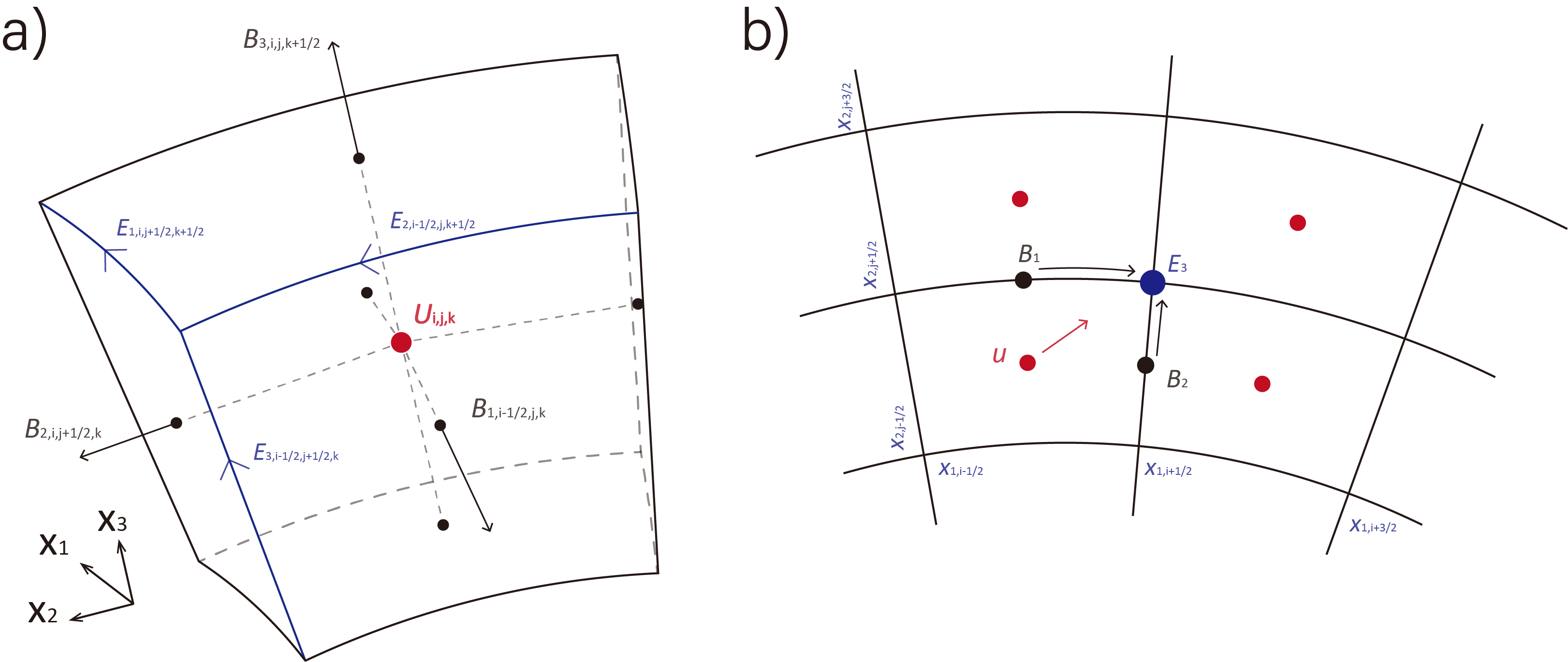
GAMERA-OP
A three-dimensional, high-order finite-volume MHD solver for orthogonal curvilinear geometries, designed for planetary, space, and astrophysical plasma simulations.
Join us
Build the next virtual planetary system.
We welcome enquiries from prospective postgraduate students and postdoctoral researchers interested in planetary plasma physics, scientific computing, and high-performance simulation.